Sunday, May 15, 2016

Checkity check yoself.

May 16, 2016

I feel it's prudent to point to the disclaimer stage right ------------------------------------->
before beginning this entry, as it contains some of my opinions on Mongolian culture. I don't think they're particularly controversial; more observations than opinions, but I understand how I and others might conflate the two. So remember: these are my opinions, not necessarily those of the Peace Corps or any affiliated agency.

Time flies when you're alive. For the most part.

That's not to say we haven't had any fun. To begin, this weekend I played judge in a speech and debate competition (Emily helped students prepare, and so could not fairly judge them). The younger students did speeches, and I really liked the judgment mechanism; students were given ten topics to prepare for ahead of time, then when the day of the competition came, they competed as teams, each drawing a topic from the original ten. They were given one minute to prepare, two minutes to speak, and then another minute or so to answer one or two questions about their speech. Some students locked up in fear; can't say I blame them, as I am very intimidating. Most did very well, despite my looming presence; piercing, icy stare; and pointed; incisive questions.

The debate competition also went swimmingly; similarly, the students were given the topic weeks beforehand, and asked to prepare arguments both for and against three statements in the general topics of economics, environment, and gender issues. The students did their research and wrote their opening and closing statements; it all went very well.

I learned a lot, I think, about Mongolian culture or at least the Mongolian mindset from judging these speeches and debates, mostly the debate. To wit: we created hypothetical scenarios to give a specific topic for the students to debate. For the environmental, we posited a scenario in which the government of Mongolia mandated that all Mongolians in the capital city Ulaanbaatar (one of the most polluted cities in the world) must move from gers, the traditional home of Mongolians since before recorded history, to apartments. The important thing to know here is that throughout the very long, very cold Mongolian winter, most Mongolians burn coal in their stoves to keep their gers warm and cook meals and whatnot. There are some 180,000 gers in the capital ger districts, and coal pretty much has to burn all day every day. The coal obviously creates a lot of problems in terms of smog and particulates, which then gets swept from the ger districts into the city proper by the constant winds of Mongolia.

Many good, relevant arguments were made; the pro side (supporting the movement) cited air pollution and health effects, space concerns, provided relevant statistics, things like that. The negative side was mostly focused on culture and the fact that it isn't gers that cause pollution but rather the coal and the inefficient stoves used, and the cost involved in moving and differences in lifestyle after the move. (Students provided a lot of other arguments, I'm just not going to list them here. Please remember this is a hypothetical intended to start debate among the students -- there's no need to tell me how right or wrong the policy is.) But one argument that was not made was about the act of actually forcing people to move from the ger districts into apartments. What do you do about people who refuse to leave?

Can you imagine having this debate in the States (you must move from your home so that we can reduce harmful air-pollution) without immediate cries of government overreach? Now, to be fair, it could just be that the students wanted to focus on the environmental aspects, but other parts of the debate strayed into areas unrelated to the environment – cost, the loss of community by being forced into apartments, disconnect from nature and the practical skills living in a ger teaches you, and the overall safety of apartments versus ger communities. I think, rather, that it's just part of the culture to be more accepting or trusting of authority. Or perhaps it's that Americans (myself included) are so over-the-top in our suspicion of authority. I don't know what to make of it, or how to respond to it; Mongolian culture has been around a lot, lot longer than American. 

Oh! And the gender debate. The debate focused on labor law; mothers with newborn children get up to four months of paid maternity leave at 70% of their income, but fathers only get seven days. Further, women may retire at age 55, whereas men cannot until 60. The hypothetical we posed in this case was that, in so many words, there should be no distinction between the sexes in labor law – no extra leave, no difference in retirement age, etc. The arguments here were what you'd expect; emphasizing physiological differences on the side arguing against that notion, emphasizing respect and humanity on the other.

Yet buried in the debate on both sides were assumptions about the role of men and women in the home and society in general. The pro side (no distinction in labor law) actually agreed at one point that women should be allowed to retire earlier because they are more worn out (the word the students used was 'stressed') from maintaining the house and raising the children. First is the assumption that all women will be married and have children, something which is so ingrained in Mongolian culture that I don't know how we missed it when forming the question. Second is the assumption that women must take care of the children and the house in addition to their jobs, and that men just work to “bring home the bacon”. No one in these debates noted that, on average, women earn more than men in Mongolia. Nor did anyone suggest that housework and child-rearing should be a shared responsibility.

I say these things not with any intent to judge Mongolia's ethical fiber, nor to cast aspersions on their way of life and doing things. Even in the States, the idea of a “stay-at-home Dad” is still somewhat offensive to our sensibilities and assumptions about what men and women should and shouldn't do. Rather, I invite those reading – from the States especially – to consider their own worldview(s), and to ask themselves how they were arrived at, and what the underlying assumptions implicit in those views might be.

And in the same way that I don't mean to judge the Mongolian perspective, I don't seek to judge American or other assumptions with this request, either. Rather, it's more that I noticed in myself that I had these assumptions, and when I witnessed a debate that completely excluded my assumptions, I was forced to ask why. I've found the exercise so far to be interesting, to say the least; it's like housekeeping for your belief system, a thing I firmly believe everyone should do as often as they can stand it.

Anyway, in other news: school is about finished, and the summer looms. Not that you'd be able to guess it by the weather, which is still in a highly volatile state; it was warm and sunny enough this morning to walk to school without a jacket, but a few hours later sees strong winds, cloudy skies, and much lower temperatures. Yesterday, Emily and I walked out to a friend's ger to see some newborn animals, specially a week-old goat which was adorable (like a cross between a dog and a cat), and a day-old calf that hadn't quite figured out how to moo. Oh, and the calf peed on Emily. It was funny. 


One last thing, since I've emphasized my disclaimer: I absolutely hate the way Mongolians knock on doors. It's a cultural thing; apartments are still relatively new to Mongolia, and in the past people could come and go from each other's gers with relative impunity in a very communal culture -- no locked doors. Now, apartments have closed, locked doors. So, if a Mongolian comes to knock on your door, expect not a "knock knock knock" to get your attention with a possible follow-up if you don't answer,  but a "knock knock knock knock knock knock knock knock knock knock knock knock knock knock knock knock knock knock knock knock knock knock knock knock knock knock knock." Pause. "knock knock knock knock knock knock knock knock knock knock knock knock knock knock knock knock knock knock knock knock knock knock knock knock knock knock knock knock knock knock knock knock knock knock knock knock knock knock knock knock knock knock knock knock knock." And this is not an exaggeration. It's infuriating. It's one aspect of Mongolian culture that will annoy me until the day my service ends. I WILL ANSWER THE DOOR WHEN I AM READY!

Monday, April 4, 2016

The Winter Grays

April 4, 2016

Happy Birthday, Brian. I really hope UNC loses. Like, a lot. You might already know who wins by the time you read this... but still. Screw 'em.

So, another long pause between posts; apologies, but these past two or three weeks have made very apparent to me why some ancient people worshipped the sun. For my part, I'd slaughter a goat or two if it meant seeing the giver of life again. It actually was out for about twenty minutes this morning, only to be swallowed by the eternal gray carpet that is our sky right now. Everywhere else in Mongolia, Spring done sprung, yet here we are in the west with gray skies and slowly-melting snow (which refreezes every night). I'd even take the dust storms currently raging in much of the rest of the country over this depressing, demotivating, motionless, silent, oppressive, formless gray. It even makes it hard to think. The gray prevails in the air, percolates into my mind, and consequently will pervade this post.

Bleck. Blurgh. Urgh, Ugh. Feh. Meh. Eh. Hh. 2015 as a year and the first two months of 2016 have been the hottest on record around the planet. In the period of 2012-2015, Uvs had winters which were far, far above the long-term average in terms of average temperature. This year, however, has been right back at that average. Give me Spring!

I don't know if it's because of the gray or because the Olympiad is over (more on that momentarily) or because we're entering the home stretch of the school year (eight weeks from today), but my students – both the adults and the young 'uns – have become far less reliable in recent weeks. My Monday movie club was a bust, and I haven't had any success in pinning down a location for a game club yet. This past Tuesday, only one student showed up to my speaking club, which should host about 25. Wednesday, my English club at the school saw five students come instead of the 15-20 I had been getting for a few weeks, and later in the day for my teacher's class, none showed up. The following day – which was, incidentally, the only sunny day in the past two plus weeks – I was supposed to hold a class for my non-english teachers at the college, but that was canceled by the teachers themselves. On Friday, even my sports club saw low attendance; I usually get 30ish students, but this time around barely breached 10. Oh, and the time of our blind students' class was changed to the afternoon, a time I can't make. I also haven't lesson-planned with my CPs in weeks due to a series of illnesses and nation-wide events. Uniquely frustrating, these things.

Some good news, though: the country recently held its nation-wide English Olympiad aimag by aimag, and I am pleased to report that my teachers took second and sixth. The Olympiad itself is just a long test that teachers, 12th graders, and ninth graders take once a year, mostly for prestige. It's taken tremendously seriously, though, and though I would love to claim that it was my superb teaching that paved the way, I work with tremendously driven people. The teacher who got sixth wouldn't let me tell the students, saying, “Next year, when I get first, I'll tell them.” The teacher who took second missed out on first by one question, which was infuriating to me. She was pleased, nonetheless, but seriously: one question. I saw her test afterward, and it actually came down to one or two words; she used the word “was” instead of “had been.” I probably would have gotten that wrong, too.

Uhhhhhh in other news: we met and had dinner with the embassy folk during a recent trip they took out here with a visiting English Fellow. We also tagged along into the city's museum, which is currently being renovated and to which we had yet to get access. They are good, dedicated people, who seem committed to spreading around some of the resources the embassy has in Mongolia, most (if not all) of which has historically been allocated in the capitol. I wish them success in that endeavor, and luck. Red tape can be ever so thick.

The aforementioned Mongolian lessons have sort of dried up due to a mixture of testing, unforeseen incidents, illnesses, and the general malaise the gray has brought on. I continue on with my Korean lessons, though, despite the fact that I am apparently an abysmal student. I can count to ten now, mostly, so that's cool.

Small victories.

And, listen, dear friend, listen: I realize that this post will come off as whiny and self-serving. And really, it kind of is, even in intent. But things are just as they have been around here; not good, not bad, just... just gray. Enthusiasm-stifling, dusk-at-all-times, happiness-smothering gray. It's not just Emily and I feeling the weather in our mood and motivation; that makes for a lot less going on. I anxiously await the arrival of true Spring, and the change in mood and action that will accompany it.


Thanks for reading.  

Thursday, March 17, 2016

February to March update

March 17, 2016

It's tournament time, and I am absolutely ready. I won't whine about the seeding my team – UK – got, because I still think they're capable of winning it all if they play to their potential. It was a... poor decision on the part of the committee, though.

So, it's been a while since the last post, mostly because very little has happened in the past month. Work and some play, work and some play. I lost my phones during an impromptu soccer match at the Uvs Lake Ice Festival, which was unfortunate. And no, that's not a typo – I had a phone my dad had given me to listen to music and take pictures, and my PC-issued phone. The phone fell out of my deel pouch (the chest area, supported by a tied belt) and into the snow, and was shortly thereafter covered. We searched for it to no avail. 

The rest of the Ice Festival was a lot of fun, though the name conjures up what is probably not an accurate image. It was essentially this: “Hey, look, the lake's still frozen even though the sun is out, and the cold won't kill you! Let's go hang out by the lake, drink vodka and eat food, and play tug of war and cards!” To which someone else responded, “Tiishdei!” (“Of course!”)

The morning was kind of funny – there had been a sports competition at my school the day before, and once it ended, my teachers all went out and drank. As a result, most were too hungover the next day to go to the lake at 10 am, which is what we had said we would do. [For my part, I played basketball with my team (FOR NINE HOURS) the first day, but after an embarrassing incident during the last sports competition, declined to play volleyball on second day.] I showed up to the school at the appointed time to find only one of Korean friends there and literally no other teachers. At one point, she tried out a word I had taught her (or I like to think that I taught her) that is a vulgar substitute for poop. Eventually, some others showed up, though, and gave us a ride around noon.

Uhhhh.... what else? A quick run off of recent things: It's still cold outside, but not very cold anymore, which is nice. Until very recently, I had been able to workout in a decent weight room in the city, but they unfortunately decided to start charging. That's a bummer. It's only the equivalent of about $15 a month, but still. Free is cheaper, and I'm on a volunteer's salary. Emily and I have started taking Mongolian lessons again, which we really enjoy and need. I found a beer (at the recommendation of a fellow PC volunteer) that's sort of a wheat beer and which I really like (mostly because it's not a lager). If someone tried to sell me a hoppy American Ale right now, I'd probably offer them my right arm. I don't know what they'd do with it, but it might end up on the table.

In the near-future: this upcoming week and weekend promises to be interesting (though not in that order). Tomorrow morning, I get to watch UK play LIVE for only the second time since I've been here, and in the NCAA tournament to boot. On Saturday, all five Uvs PC volunteers (PCVs hereafter) will be together to celebrate St. Patty's day with our Korean friends and, if they come, a few Mongolian friends. On Sunday, a representative from the US Embassy will visit and deliver a seminar to the English teachers in Uvs. On Monday (I think), we will have dinner with them; we had dinner with the consulate last year and that was a lot of fun, so I expect this will be as well. On Monday and Tuesday, Uvs will hold its annual Academic Olympics, including an English Olympiad, which we've been preparing our students for for some time. Tuesday, I actually get to help grade those tests, which I'm looking forward to. I don't know why, but I like grading, and since the grading is blind, I don't worry about being partial.


Anyway, thanks for reading.  

Wednesday, February 24, 2016

The Winter Blues

February 24, 2016

Happy birthday, sister! Try not to let it go to your head.

Evidently, February is the month that "the winter blues" finally got me, and good (although for me, it's more like "the winter anxieties"). When you're rooting for the temperature to hit 32 F because that's almost 100 degrees warmer than it was for two or three weeks and is a reasonable temperature to be outside in, when a sunny day tricks you into thinking it's warm because you haven't seen much sun in the past two months, when you look forward to being able to walk to school without your breath freezing on your glasses (not fogging, freezing), and when you look forward to snow because that means it's warm enough for moisture to form in large enough amounts to count as precipitation -- that can wear one down.

To be fair to Mongolia, February is usually my least-favorite month (although some years January takes the cake), and I've struggled with winter from a mental-health perspective for as long as I can remember. Nonetheless, this one has me thinking more and more about what I can do to overcome this feeling of malaise, and my sometimes desperate desire to see something green.

Emily recently provided me a link to a blog which she follows somewhat religiously called "Mr. Money Mustache" about a dude who managed to save up enough money to retire when he was, no joke, 30 years old. The money part of it is less interesting to me, at least at this point in my life, but the blog's author focuses a lot on mentality, and the post Emily recommended to me is about one of the first habits listed in the "Seven Habits of Highly Effective People" -- in this case, identifying the things that stress you out or cause you consternation, and trying to separate them into groups of "can control" and "cannot control".

I've made a list of such things; for instance, I cannot control whether UK wins the NCAA tournament this year, no matter how long I go without washing my favorite UK shirt. I cannot control whether the global economic system collapses, I cannot control the condoned and lauded anti-science views of half of the US electorate, and I cannot control the length and intensity of the Mongolian winter. I can control, however, my posture, how often I write, my tendency to overschedule, and how much time I spend playing video games.

I've found it helpful and incredibly centering to think of things in terms of what I can and can't control. If nothing else, it helps me to realize that there are things that are well within my circle of control that could (and in some cases eventually will) be impossible for me to do. For example, I'm young, physically fit, and reasonably intelligent, so many of the problems that I see in my life right now can be overcome. Some day, I may have a stroke and be unable to speak, or lose a leg in a freak roller-coaster accident and be unable to run. But today is not that day.

That being said, there are some things which I'm less sure about; my tendency toward addiction (see video games), my failing in learning Korean, and my continual battles with my bowels notwithstanding. Which category do these things fall in? Where does mental disease fall into this, and what are the lines there? I.e., do I have a mental disease in anxiety, or am I just undisciplined?

A more difficult question, for me, revolves around climate change. As most of you know, I am firm in the knowledge that this is the most important threat facing humanity at this point. Yet is it something I can control? Of course not. I can advocate for serious climate change action and legislation, I can vote for people who say they will uphold the international agreements to which we are already party, and I can take steps to limit my own carbon footprint. But ultimately, much of that lies so far outside of my sphere of control that it sometimes feels pointless to even try. 

And we come full circle! I despair about some of the things I cannot control because they seem to be every bit as important as the things that I can control. I can rationalize all day about why it's in my best interest and the best interests of those who I love for me to do everything I can to fight against climate change, but if I'm focusing on things I can control, the problem becomes far more complex than that (damn you, life, resisting simple dichotomy!). For example, is it my responsibility to do something about climate change? Two of the most important goals are to stay healthy and happy, and I think of that as a thing that I can control. Am I wrong in the face of something that will undoubtedly impact both of those things?

Short answer: no, probably not. Cancer can also kill me, and there are thousands of things we know of that cause cancer, aging notwithstanding. In some places, being outside is one of them. A supervolcano could erupt, an asteroid could impact Earth, or a Coronal Mass Ejection could destroy the electrical infrastructure around the world. Should I spend my life advocating for preparation in the face of these things which will, statistically, definitely happen?

Is it my responsibility to stop climate change? Well, in a way yes, but ultimately it's everyone's responsibility. I can do what I can to advocate for change, but if it's just me, it's pointless. I can scream and shout on the steps of the Capitol about preparing for an asteroid impact, I can hem and haw on street corners about the dangers of speculative investing and negative interest rates, and I can set myself on fire to simulate what might happen if the Yellowstone Supervolcano erupts, but it's just leaves in the wind if I'm the only person trying.

Take a more concrete example: I want to make Emily happy in life. Is that a thing I can control? No. I can control how I treat Emily, how I act toward her, but if tomorrow something terrible happens to her, she's probably going to be sad.

Ultimately, this "can and cannot" exercise proved extremely helpful to me. Not only by way of categorizing, but by giving me a perspective on my own anxiety, and the frankly illogical impositions I've put on myself. Long story short: give it a try.

Thanks for reading. Here's a picture of Emily with a dead fish in a bucket as a reward for your perseverance:

Monday, February 15, 2016

Tsagaan Sar Pictures

Tsagaan Tsar is, as you might know, the Lunar New Year. This will be a quick one-off post to share some of our experiences during the week-long event.

Officially, actually, the government allows for three days to celebrate the holiday, but in the countryside where herders mostly live, it can go on for about a month.

In our experience, it went something like this: day 1, kids visit parents' and grandparents' homes. Day 2, younger siblings visit older siblings' homes. Day 3, older folk visit younger folk's homes. Day 4, friends and coworkers. There's nothing strict about that setup; we visited families every day except the first, and actually visited a friend well after day 4; rather, these are the general guidelines.

When you get to the ger or apartment or house or whatever, you immediately greet the hosts: first the men, oldest to youngest, then the women, oldest to youngest. Technically, if you're older than a child or something like that, they're supposed to greet you. The greeting itself is a quick thing; hold your arms out as if you're carrying a box and meet the other person in the same fashion, younger person's arms on the bottom, then touch cheeks on both sides and give a normal greeting. Sometimes, the oldest will hand you their bottle of tobacco, which typically you wouldn't actually take a whiff from, only sniff near the cap, then hand back. The bottle itself is usually a very expensive crystal or bone or jade or something bottle, filled with a fine powdered tobacco that you would snort. I've done it once or twice, and it's a craaaazy head rush.

After that, it's eat, drink, eat, drink, eat, eat, eat, drink, drink, drink. Traditionally one eats buuz (pronounced more like "boats" than "booz"), a steamed meat dumpling kind of thing. All the while, you're drinking milk tea and being handed shots of vodka, typically by the oldest male host. Thankfully, they don't expect you to drink the whole thing (or even any of it, necessarily), as most Mongolians use double shots or larger.

Eventually, you'll exchange gifts, and eventually, you'll leave.

Anyway, here's some pictures. See if you can tell which ones involved the most vodka.

Saturday, January 30, 2016

More pictures and semi-random thoughts.

Can a thing be semi-random?

A few more pictures, and some quick updates:

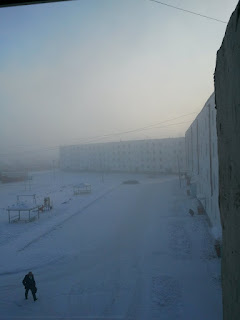
It is now -40 during the day and -50 at night. The doors to the porches are literally frozen shut -- the condensation from inside the apartment (cooking and breathing and whatnot) freezes at the base of the doors over night. I actually went to a store near us, and on the inside of the store's door, the lock had been frozen. We're not talking about a keyhole lock or something like that, but a normal kind of lock you'd expect to see anywhere.

Also, there are a few manhole covers around the city, and they spout steam. The steam does not, however, usually make it all that far -- it forms a sort of vent of the sort you'd see when someone on a science show tells you that life probably originated around hot vents spewing sediment at the bottoms of the oceans. A spout, of sorts. It's neat.

Other than that, Tsagan Tsar (Lunar New Year) approaches, and it is now dark as late as like... 630. So that's cool. That's up from 330-4 earlier in the year.

In any case, here's some pictures:

We had our creative writing competition this past weekend, a wild success that saw something like 86 students in our aimag center alone. I forgot to take pictures of that, though, so here's a picture of the main road in our city.

ACTION SHOT OF EMILY TEACHING!


ACTION SHOT OF ERIC GETTING WAY TOO CLOSE TO THE BOARD! HE NEEDS A HARICUT!

A feel for how foggy/smokey it gets overnight when the temperature dips below -40. It's usually worse earlier on.

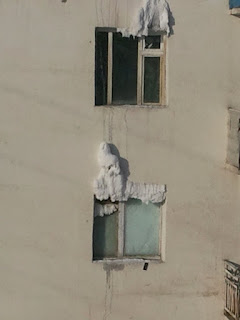
See if you can spot the windows leaking heat.

A few of our kids from the WriteOn classes Emily and I taught together.

The school I work in. ... oh, sorry. In which I work.

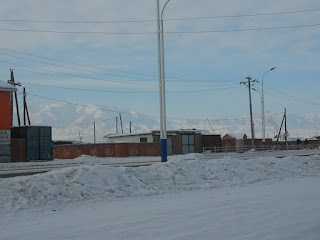
An only-slightly obscured view of the mountains to the... either North or South or East or West of our apartment. One of those.

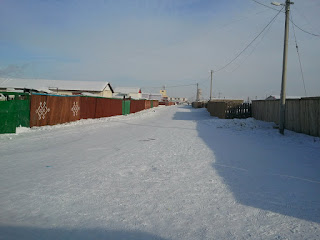
A view of my (Eric's) walk to school.

Frozen windooooowwwwww.

Another view of my walk to work. It is followed immediately by the next picture, which is the "interior" of that break in the fence.

The break in the fence. Two people attempting to go through at the same time always turns into a dance.


Sunday, January 17, 2016

Super amazing and enthusiastic blog post

January 17, 2016 (Sunday)

Still very, very little happening around here. I've been re-upping on my Korean lessons, which is good, but starting at the end of next week, there will be no classes (for me to teach at the college) for threeeeeeeee weeks. This is because there is a national holiday in February called Sagaan Saar, the celebration of the lunar new year. The actual holiday takes place over about three days, but my school operates under the department of labor in Mongolia (not the dept of education). That's how they do, you know?

I have no idea what I'm going to do. Work on clubs and lesson plans, I guess, and get really good at Spades again. If I could find some wood to carve, I'd start making a mah jong set, but I don't even know where to look. Ah well.

It's finally dipped into the -35 to -40 degree range, which is somewhat exciting in its own way. I will say, though, that there are still kids outside (when it's sunny) playing soccer. I can remember times as a kid when people wanted to cancel classes because it hit 0 outside. One of the many consequences of an overly litigious society, I suppose.

A funny observation: up until the past few days, I've been warm enough in my apartment that I've been able to wear shorts (albeit with long socks and slippers) and not get cold. The diving temperatures outside have made that impossible lately. Just think about that: the construction and insulation is good enough here that, until it hit -35 degrees, I was able to wear shorts inside without getting cold.

In Mongolia, they measure the winter by a series of nine nine-day periods (i.e., 81 days), in which things get progressively colder until about the 4th period (which I believe we're in right now). I've made up my own system: comfortable without slippers and in a light long-sleeved shirt; comfortable with slippers and a light long-sleeved shirt; comfortable with slippers and socks and a light long-sleeved shirt; comfortable with thick socks, slippers, light shirt; comfortable with thick socks, slippers, thick shirt; and the current temperature, comfortable with thick socks, slippers, pants, and a long-sleeved shirt. It's a major consolation that February is generally warmer and sunnier than January (still in the -20 to -35 range, though).

Um... let's see. This past Saturday, Emily and I taught together for the first time (outside of Monglish night); a seminar on creative writing. We taught one class of younger students and one class of 11th grade and up students, each two hours long. In the younger class, we got through far less of our material, but in the older class we finished almost all of it. We focused a lot on writing a good introduction. It went well, we think, even if we did step on each others' toes once or twice during the first lesson. A little of that is to be expected. We'll do it again next Saturday, then the following Saturday we'll have a creative writing competition (under the auspices of the WriteOn International competition, a Peace Corps project started in, I think, Georgia).

Our weekly Monglish night meeting was BIG this week, with probably 15 people. That might not seem like a lot, but in the past, it was five or six people sitting around on the couch in our apartment. Monglish night has fast become one of my favorite things to do, because it's specifically not a class. We're just practicing English with a bunch of people who want to improve, playing games and not taking it too seriously. It is incredibly refreshing. I am wondering, though, if maybe breaking it up into two groups might help things flow, if it keeps getting bigger.

UhhhhhhhhhhHHHhHhHhhhHhh otherwise I've been keeping an eye on the markets' continual dive, and reading doom-and-gloom reports about 2016 and the end of society as we know it. One way or another, 2016 is probably going to be a bad year economically: the first few weeks of the year serve as predictors for how the rest of the year will go almost 75% of the time. I also read a report from Lloyd's of London, among the most respected insurance companies in the world, predicting... well, predicting bad things. Food supply shocks and resulting food riots, water shortages and an increase in instances of disease, and in general failure of governments and societies to adapt quickly enough to any number of climate-change driven catastrophes. Lloyd's thinks that, if we continue with business as usual, human society by 2025 won't be recognizable as such.


Okay, I'll back off of that. It's occupied a lot of my time and thinking lately, though, so I couldn't resist a little bit of morbid speculation. I am getting well off the tracks here, though, so maybe this is a good stopping point. yeah? Yeah.